
Four days in January, with Wildlife Worldwide, led by Sean Weekly.
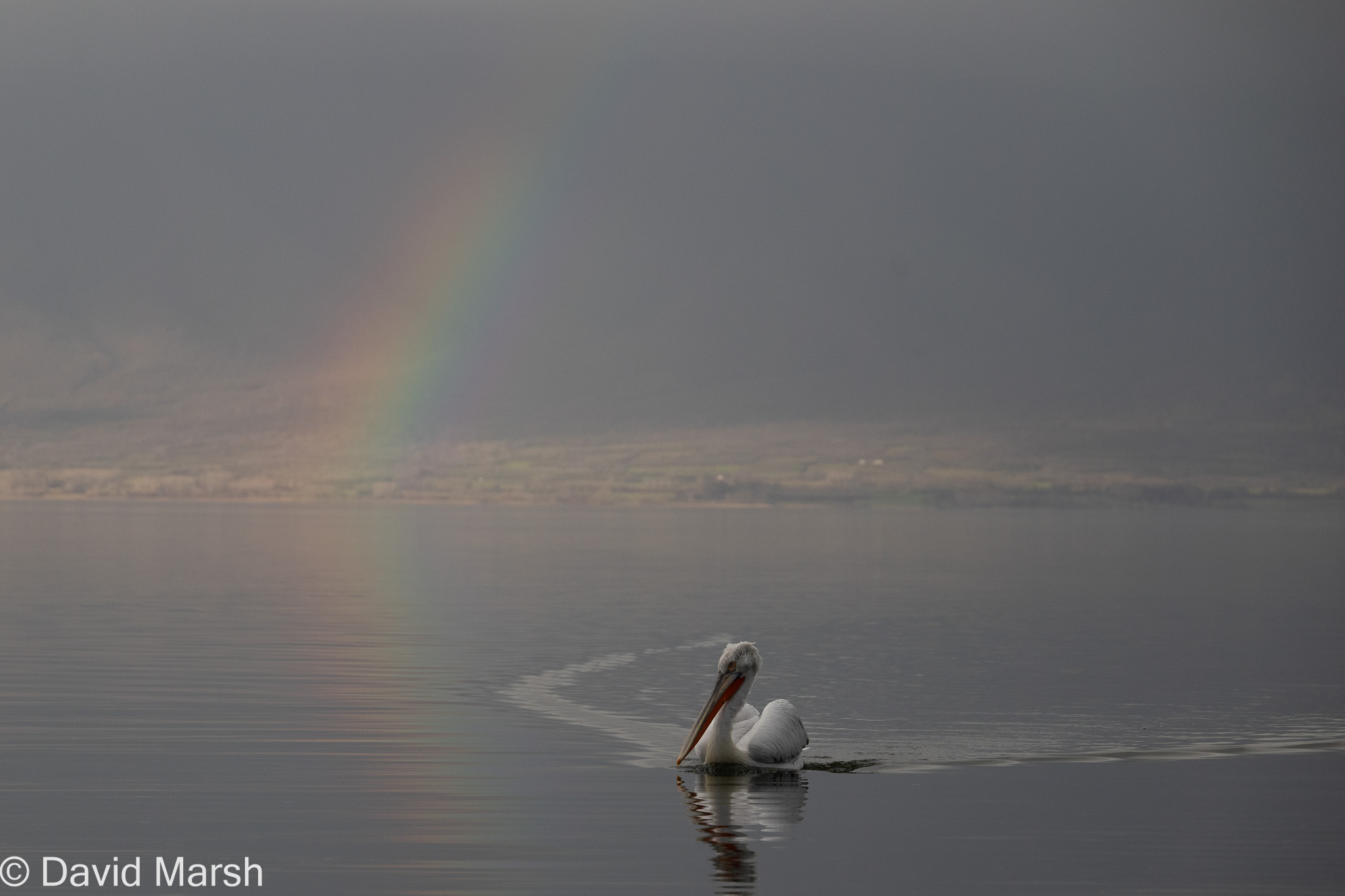
Sean has been running trips to Lake Kerkini for many years, this year hosting four, back to back during January. For one guest it was her fifth trip. Typically it is very cold, with clear skies, but this year, for our few days, it was very different. Rain, mist, fog, gales, storm clouds, rainbow and just the occasional glimpse of the sun. However, it was a bit warmer than usual so I didn’t need all the thermal layers that I had brought.

Lake Kerkini is an artificial reservoir in Central Macedonia, Greece that was created in 1932, and then redeveloped in the 1980’s, on the site of what was previously an extremely extensive marshland.
Lake Kerkini is now one of the premier birdwatching sites in Greece. Its size varies from 54 km2 to 72 km2. (c.f. Disney World @ 100km2) The lake is a technical work of great agricultural utility and provides a hydro-biosphere for thousands of water fowls.
Human intervention usually retracts or takes negative action against the natural processes. Lake Kerkini is a rare example, where the gentle human handling has had the exact opposite result.

The Dalmatian pelican (Pelecanus crispus), also known as the curly-headed pelican (crispus meaning “curly” in Latin), is the largest member of the pelican family and among the heaviest flying birds in the world. With a wingspan typically ranging between 2.7 and 3.2 metres it ranks among the largest soaring birds. These pelicans are known for their graceful flight and often travel in synchronised flocks.
The Dalmation Pelican was first described in 1832 based an a specimen shot in Dalmatia (Croatia), and one of the first formal illustrations of the bird was produced by Edward Lear. Although the species was considered extinct in Croatia since the 1950s, a lone Dalmatian pelican was observed there in 2011.

Throughout the 20th century, the Dalmatian pelican underwent a dramatic decline in numbers, becoming one of the most threatened pelican species. Habitat loss due to wetland drainage and land conversion is considered one of the primary drivers of this decline. The global population of the Dalmatian pelican is now estimated at between 10,000 and 20,000 individuals, with roughly 3,000 to 5,000 breeding pairs, mostly found in Russia. There is a breeding colony of about 1600 pairs at Small Prespa Lake, in Greece on the border with Albania. The Kerkini population is somewhat smaller, and both Prespa and Kerkini suffered significant losses from avian flu.
The Dalmatian pelican is a piscivorous, non-apex predator, functionally classified as an opportunistic secondary-to-tertiary consumer. It forages across freshwater, brackish, and coastal ecosystems, primarily during crepuscular hours, using shallow-water surface capture techniques.

In winter, when the water is cooler, the fish swim lower and are harder for the pelicans to catch. They then take advantage of the cormorants, who work together to flush the fish and bring them to the surface. In some places pelicans have been regarded as competition for the fishermen (actually, it’s the deeper diving cormorants that are the real competition), but on Lake Kerkini they have been fed with fish (mainly carp) which wouldn’t sell in the market. As well as helping the pelican survive over the cold winters, it opens up the possibility of photographic tourism, bring much needed income to remoter communities.
Sources:
- Lake Kerkini Wikipedia
- Dalmation Pelicans Wikipedia
- Lifelines, by Julian Hoffman – for more abuot Lake Prespa (and pelicans in Chapter 10). Review b Mark Avery.
Special thanks to Sean for help with Lightroom editing, and helping me to make the photos “pop”. Let me know in the comments what you think – and maybe tell me which one might be your favourite photo.
Select any thumbnail below for a full screen slideshow
You can now comment on individual photos in the gallery. Look for the comment button top right.


-
I think all the photos where the pelicans are attempting to catch fish are great. Their beaks are huge, aren’t they!




9 replies on “Pelicans of Lake Kerkini”
Awesome pictures David. I can’t really pick a favourite, aside perhaps of the one landing?
Big critters, aren’t they.
Wonderful pictures, David, thank you!
Great subjects, and a mirror-like lake. I vote for the first, sunset one- but it’s a difficult choice!
Fabulous, extraordinary birds; fabulous pictures ! At present I only have access on my phone, So I long to see the images bigger. The ones where you’’ve captured low flying bird(s) and their reflections with very little light it seems, and on completely still water , it took me a while work them out, and realise birds don’t fly upside down! . I hope that’s a happy side effect of ‘bad ‘ weather.
I hope you’ve recovered from being cold and wet!
Great photos David, lots to like! The rainbow shot and mid section reflection photos are very good, but all round great set
Looks a fabulous trip and gorgeous photos. For some reason I can’t comment on individual pictures, but will email.
Is the pelican behind you on the boat for real?
Yes, real, and obliging, pelican. Allowed some of us to swap round and pose. Their behavour round the boat varied. When calm and still they ventured close, but kept their distance when it was rougher and windier.
EXQUISITE PHOTOS, David; breathtaking. My favourite is the 2nd of the nighttime pelicans, sitting on the black water, silver wings appearing to function like arms, lifting itself out of the water like a primeval apparition displaying his powerful red beak. The clarity and composition of every image is truly moving
I was a bit deflated last week when I submitted two of them to my local photography club competition. Both were “nice” but got no further because the sunrise one was grainy and the “heron” wasn’t sharp, and the head closeup was cropped too much; he wanted to see the whole beak. In general, it seems that wildlife photos don’t mix with other photographic genres, and judges at best don’t know what to do with them, and at worst just don’t seem to like wildlife photos. Or maybe my photos really aren’t quite as good as I’d like to think they are!!
Here’s more encouragement, by email. Thanks Helen.
“Your shots are cracking. I particularly love the ones with feather detail, and the one with the backlit lower mandible with the two going for the fish, the water droplets, and line of pelicans on the horizon – brilliant! I can see why people keep returning to Kerkini. Every trip gets such a wonderful variety of conditions and results.” [this one?]